
Age-related macular degeneration (AMD) is a chronic, progressive disease of the central retina (the macula) leading to the painless loss of central vision.

It is the leading cause of irreversible vision loss in individuals over 50 years of age in industrialized countries and represents a strong burden on patients’ everyday life, impacting their ability to read, recognize faces, and see objects and, ultimately, leading to irreversible vision loss in the elderly.
In all its forms, AMD represents a compelling unmet medical need for more effective and durable treatment options, with a large and rapidly growing market projected to reach $27.5 billion by 2031.


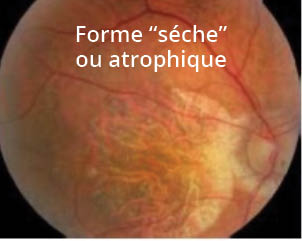
Dry AMD
- Also called non-exudative or geographic atrophy (GA) for the late stage.
- Represents ~85–90% of AMD cases.
- Slowly progressive degeneration of photoreceptors and RPE.
- Characterized by drusen (lipid–protein deposits) accumulation and progressive thinning of the macula.
- Driven by oxidative stress, mitochondrial damage, lipid peroxidation, and inflammation.
GA represents the final stage of the disease, characterized by well defined areas of photoreceptors and RPE loss, leading to irreversible central vision loss.
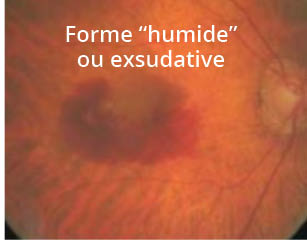
Wet AMD
- Also called exudative or neovascular AMD.
- Represents ~10–15% of cases, but causes ~80–90% of severe vision loss.
- Characterized by abnormal growth of blood vessels from the choroid (choroidal neovascularization), leading to leakage, macular edema, and rapid loss of central vision, if untreated.
- Repeated leakage and scarring lead to progressive macular atrophy and subretinal fibrosis, resulting in permanent vision impairment.
- The key pathological mechanism is excess VEGF, which stimulates abnormal vessel formation.
- Current standard-of-care anti-VEGF therapies reduce leakage and macular edema but do not address the underlying degenerative processes that cause macular atrophy and fibrosis.
AMD affects approximately 200 million patients worldwide, and this number is expected to reach 300 million by 2040,1 notably due to the aging of the population. The disease affects about 10% of the population from 60 years and more than 25% after the age of 80.2
1 Wong WL, Su X, Li X, Cheung CMG, Klein R, Cheng C-Y, et al.
Global prevalence of age-related macular degeneration and disease burden projection for 2020 and 2040: a systematic review and meta-analysis. Lancet Glob Health. 2014 Feb;2(2):e106–116. doi:10.1016/S2214-109X(13)70145-1. PMID: 25104651.
2 INSERM, rapport Dégénérescence liée à l’âge » April 26th ; 2024