
PST-809 – in wet Age related Macular Degeneration (AMD)
Wet AMD is characterized by rapid and severe vision loss driven by:
- Pathological choroidal neovascularization (CNV)
- Vascular leakage and macular edema
- Loss of retinal pigment epithelium (RPE) leading to macular atrophy and subretinal fibrosis
PST-809 is a plasmid expressing two complementary therapeutic proteins: aflibercept, a potent anti- vascular endothelial factor (VEGF), and decorin, a native an anti-angiogenic and anti-fibrotic protein. Together, these proteins target CNV, vascular leakage, while also protecting RPE cells and limiting the development of macular atrophy and subretinal fibrosis.
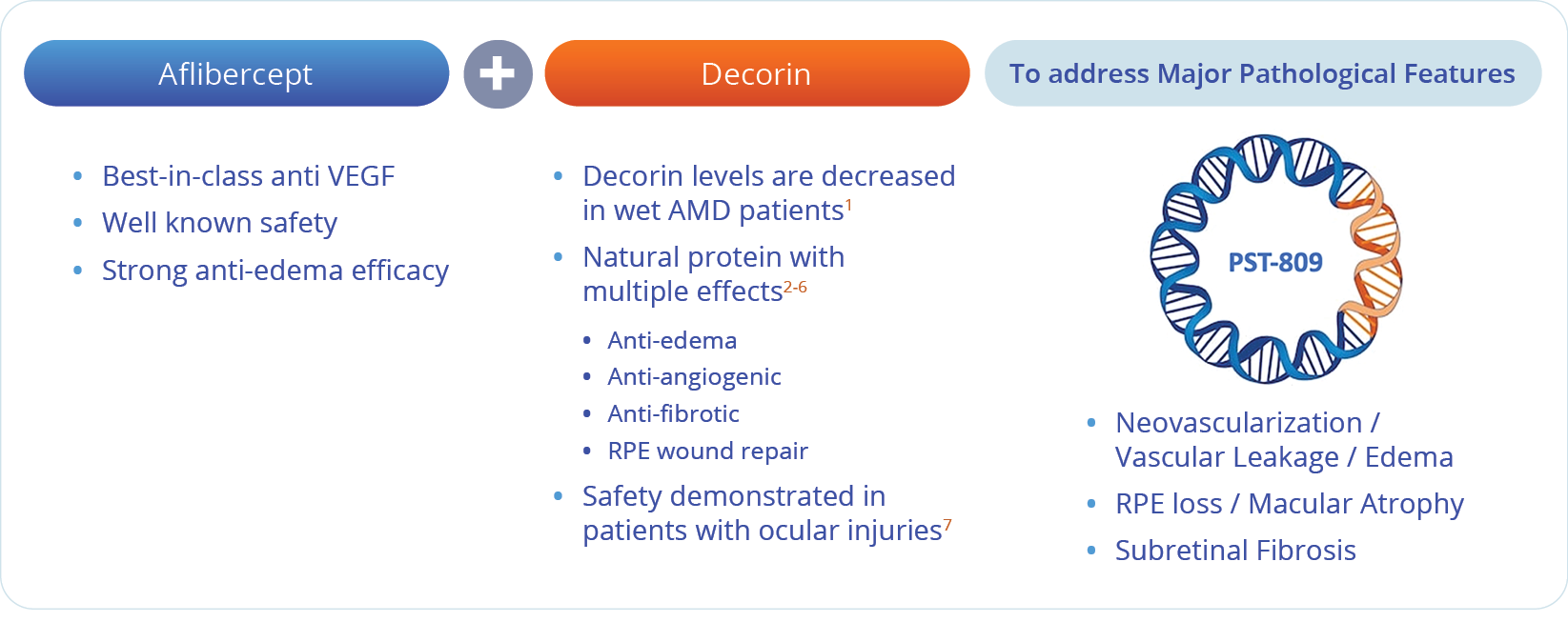
PST-809 Benefits
Existing anti-VEGF therapies effectively reduce vascular leakage in the short-ter but require repeated intravitreal injections every 4 to 12 weeks to maintain efficacy, which imposes a significant burden on patients and caregivers, leading to suboptimal long-term compliance.
By acting on multiple disease-driving pathways, PST-809 is designed as a first-in-class treatment, clearly differentiated from conventional anti-VEGF agents due to its unique ability to target both VEGF-dependent and VEGF-independent pathways. Notably, decorin among other targets, inhibits the TGF-β pathogenic cascade involved in the expression of angiogenic related molecules and mediating inflammation and subretinal fibrosis formation. The inhibition of TGF-β signaling has been shown to reduce the CNV formation and firbrosis8.
Moreover, the sustained intraocular expression of both therapeutic proteins has the potential to reduce significantly reinjection frequency, thus lowering treatment burden and improving patient compliance.
Thanks to its dual and complementary mechanism of action and its potential for long-lasting efficacy, PST-809 holds the potential to address patient that are not properly responding to the current anti- VEGF-based treatment.
| 1Yuan, Molecular & Cellular Proteomics (2010) 9:1031 | 5Wang Invest Ophthalmol Vis Sci. (2015) 56:2971 |
| 2Du, Exp Eye Res. (2013) 116:151 | 6Invest Ophthalmol Vis Sci. (2015) 56:3743 |
| 3Wang, Scientific Reports (2017) 7: 9672 | 7Abdullatif, Graefe’s Arch Clin Exp Ophthal (2018) 256:2473 |
| 4Zhao, Nature Communications (2019) 10:369 | 8Wang et al. TGF-β participates choroid neovascularization through Smad2/3-VEGF/TNF-α signaling in mice with Laser-induced wet age-related macular degeneration. Sci Rep 7, 9672 (2017). |